

MESLANGES HARMONIQUES
Since ancient times, polyphony and various contrapuntal techniques had been used to represent celestial harmony and the immutable movement of the stars, and the correspondence between these phenomena and human activities. The Renaissance gradually overturned this conception, offering more varied expressive universes in which, moreover, learned music and popular music often went hand in hand.
Songs
The invention of music printing in Venice at the dawn of the 16th century, an innovation that would soon spread to all European cities, radically changed the aesthetic world of the West. Painting followed suit, with countless representations of allegorical figures and people from all walks of life making music. Publications flooded the market, making songs, motets, and madrigals immediately accessible to all, and encouraging both the development of musical practices on an unprecedented scale and the emergence of new types of compositions, from the most scholarly to the most accessible.
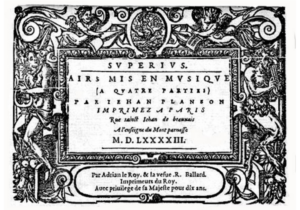
After the Franco-Flemish chanson, popularized in the 15th century by Gilles Binchois and Johannes Ockeghem, secular vocal genres multiplied, with a whole new freedom of counterpoint. Alongside the Italian madrigal, essentially on the theme of love, and its simplified derivatives, the Parisian chanson experienced spectacular growth, particularly with Clément Janequin. The texts
used were thematically varied and ranged beyond the usual romantic themes; they “provide a very complete picture of everyday life at the time” (Jérôme Lejeune). One of the many masters who devoted themselves to the genre was Fabrice Marin Caietain. He was born in Italy, worked first as an organist in Naples before moving to France. He lived in Nancy, Paris, Avignon, and Toul, where he was maître des enfants at Notre-Dame Cathedral. Abandoning the strict imitative techniques of counterpoint, his first collection of Airs mis en musique à quatre voix, published in 1576, displays the use of “light homophony, enlivened by declamatory rhythms” (Annie Cœurdevey). This simplification gave rise to the air de cour. Initially polyphonic, its structure, essentially homophonic, gave the leading role to the upper voice, and soon dispensed with the other voices in favor of the basso continuo. Jehan Planson, an organist in Paris, published Airs mis en musique à quatre parties… tant de son invention que d'autres musiciens (Four-part airs set to music… both his own compositions and those of other musicians) in 1587, in which this trend is evident in the syllabic writing, short musical phrases, and easy-to-remember melodies.
Instruments
The transcription of vocal works into instrumental scores facilitated their performance on instruments. Publishers quickly took advantage of this new practice by offering numerous adaptations of vocal compositions for the lute, keyboard instruments, and various ensembles or consorts, particularly those formed by instruments of different sizes from the same family, such as violas da gamba or recorders.
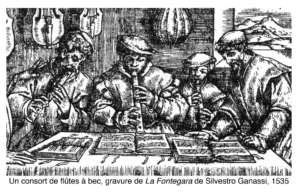
On the other hand, musicians have always made use of improvisation, embellishing their performances with various ornaments according to the circumstances. From the mid-16th century onwards, numerous treatises set out guidelines for this practice. That is, they provided instructions on the best ways to produce, with taste and intelligence, what are known as diminutions or divisions in English, passaggi in Italian, glosas in Spanish: short passages used to fill, sometimes in a virtuoso manner, the intervals between the long notes of a melodic line. These are the first examples of what would become the genre of variation, destined for a brilliant future.
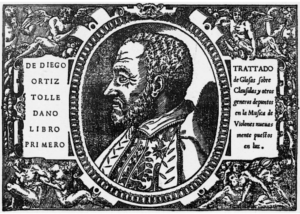
These treatises draw their examples from the most popular madrigals and French songs of the time, such as Doulce mémoire by Pierre Sandrin, Oncques amours by Thomas Créquillon, and Frais et gaillard by Clemens non Papa. These three pieces can be found, respectively, in: Tratado de glosas sobre cláusulas y otros géneros de puntos en la música de violones nuevamente puestos
en luz, published in Rome in 1553 by Diego Ortiz, a musician from Toledo who settled in Italy; Il vero modo di diminuir con tutte le sorti di stromenti di fiato, & corda, & di voce humana, published by Girolamo della Casa in Venice in 1584; and Motetti, madrigali et canzoni francese di diversi autori diminuiti per sonar, published seven years later in Venice by Giovanni Bassano, a musician at St.
Mark’s Basilica.
Polyphony did not lose its appeal, however, as evidenced by the numerous fantasias composed by the English over nearly a century for viol consort. The French composed little in this genre, but we can mention the Fantaisie à 5 parties by Jean Henry le jeune, a violinist with the Chambre du roi and a member of Les Vingt-quatre Violons du Roy. This work was included in the fourth volume, devoted to string instruments, of Marin Mersenne’s important treatise Harmonie Universelle, published in Paris in 1636.
Keyboards
Until the dawn of the 16th century, keyboard instruments were used solely to transcribe sacred and secular polyphonic vocal works, but throughout the Renaissance, their repertoire expanded to include scholarly pieces and dances that were equally suited to the organ, harpsichord, or clavichord. It was in the 17th century that a distinction was made between these keyboard instruments, with some pieces requiring the pedalboard of the pipe organ or being part of the liturgy, and others being more suited to the intimacy of salons.
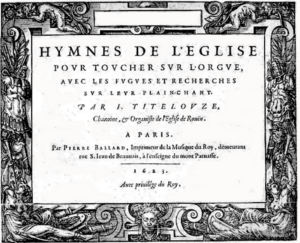
The first organ book worthy of the name, a collection entitled Hymnes de l’église pour toucher sur l’orgue avec les fugues et recherches sur leur plain-chant (Church hymns to be played on the organ with fugues and studies on their plainchant) by Jehann Titelouze, was published in France in 1623. Titelouze’s style was more austere than that of his contemporaries. A lifelong organist and canon at Notre-Dame Cathedral in Rouen, as well as an expert in organ building, Titelouze was also a poet. In keeping with custom, his compositions, linked to worship, set half of the verses of the hymns and the Magnificat to music, with the cantors singing the others in alternating Gregorian chant. The organ verses are based on the plainchant melodies specific to each one, used as cantus firmus or as a fugue theme with great ingenuity. Johann Jacob Froberger, a great traveler who identified himself, precociously, as a European, was one of the most eminent keyboard players of the 17th century. After studying with Girolamo Frescobaldi in Rome, he lived in Vienna, Paris, Brussels, Amsterdam, London, and Dresden, immersing himself in all the musical trends of his time. He left only compositions for keyboard instruments, including severe ricercares and contrapuntal fantasies; freer toccatas, capriccios, and canzonas; and dance suites for harpsichord.
During a stay in Paris in 1652, he accompanied the lutenist Charles Fleury de Blancheroche after a dinner party. However, on arriving home, Fleury stumbled, fell down a flight of stairs, and died shortly afterwards in Froberger’s presence. Froberger then composed his moving Tombeau fait à Paris sur la mort de Monsieur Blancheroche (Homage written in Paris on the Death of Monsieur Blancheroche), which was to be played “at discretion”—that is, as an unmeasured prelude. A kind of meditative improvisation, the work “sobs with an organized and sovereign flow” (Renaud Machart), and ends with a descent of two octaves into the lower register, illustrating a very unfortunate fate…
Dances
In the instrumental field, serious genres and the most imaginative variations rub shoulders with various dances whose style and rhythms betray their rural origins.
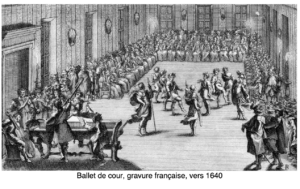
Numerous books of danseries—collections of harmonized dance tunes—were published in the 16th century by Tielman Susato and Pierre Attaingnant. The most accomplished example of the genre remains Terpsichore, Musarum Aoniarum, published in Wolfenbüttel in 1612 by Michael Prætorius, a great theorist and extremely prolific composer. His collection of arrangements, presented in a remarkably opulent polyphonic texture, include several dances, some by Pierre-Francisque Caroubel, which featured in the ballets of the
French court. Born into a family of musicians and a distant cousin of Molière, Michel Mazuel was a member of Les Vingt-quatre Violons du Roy from 1643 to 1674. He participated in numerous court ballets. Extravagant spectacles combining music, song, and dance, they were beloved by Louis XIV and his family, who joined in alongside professional dancers. Some of Mazuel's music, including a
suite for treble and basso continuo—which, following Prætorius’s example, could be expanded with intermediate parts—can be found in a manuscript collection compiled by Louis XIV's music librarian, André Danican Philidor the Elder. In 1690, Philidor was entrusted with the task of collecting the “old airs composed for coronations, weddings, and other solemn occasions during the reigns of Francis I, Henry III, Henry IV, and Louis XIII, along with several concerts composed for their entertainment.” A commission that today contributes to our enjoyment…
© François Filiatrault, 2026
Translated by Seán McCutcheon