
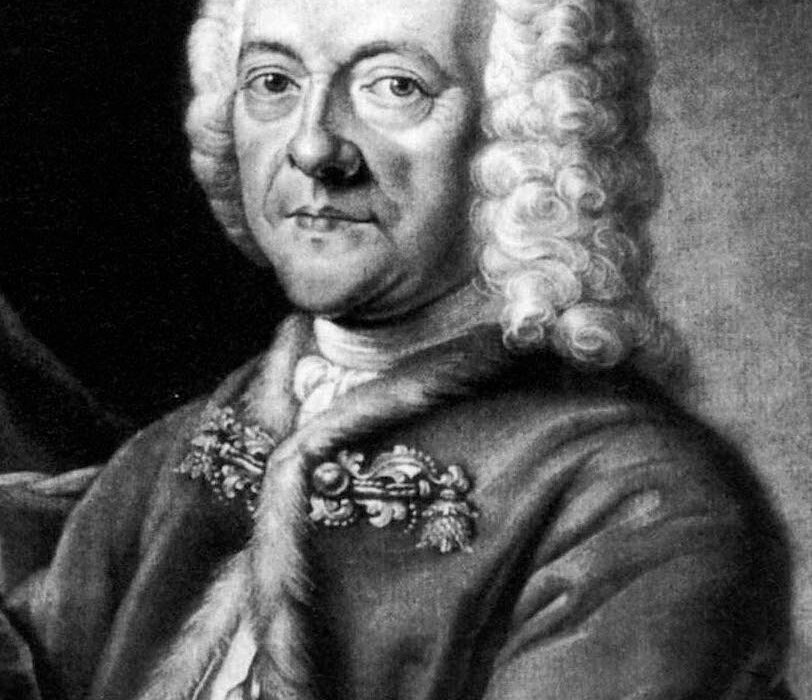
GEORG PHILIPP TELEMANN
Telemann was at home in all styles, possessing a supreme mastery of both the French and the Italian modes (regarded at the time as virtually contradictory) in their purest forms as well as all the intermediate stages in their coalescence.
Nikolaus Harnoncourt,
Baroque Music Today: Music as Speech, 1995
In his three autobiographies, written at different points in his career, Georg Philipp Telemann describes his early education. At the high school in his hometown of Magdeburg, he studied the basics of Latin, poetry, and music theory for two weeks with the cantor Benedict Christiani. Then, at the gymnasium in Hildesheim, impatient and curious about everything related to the art of sound—“God and Nature truly destined me for music,” he confides to us—he refused the tutelage of an old-school organist who wanted to teach him organ tablature. Instead, he became essentially self-taught, studying the scores that fell into his hands and composing his first opera at age 12. All of this, of course, was despite his mother’s repeated prohibitions; he was four when his father died.
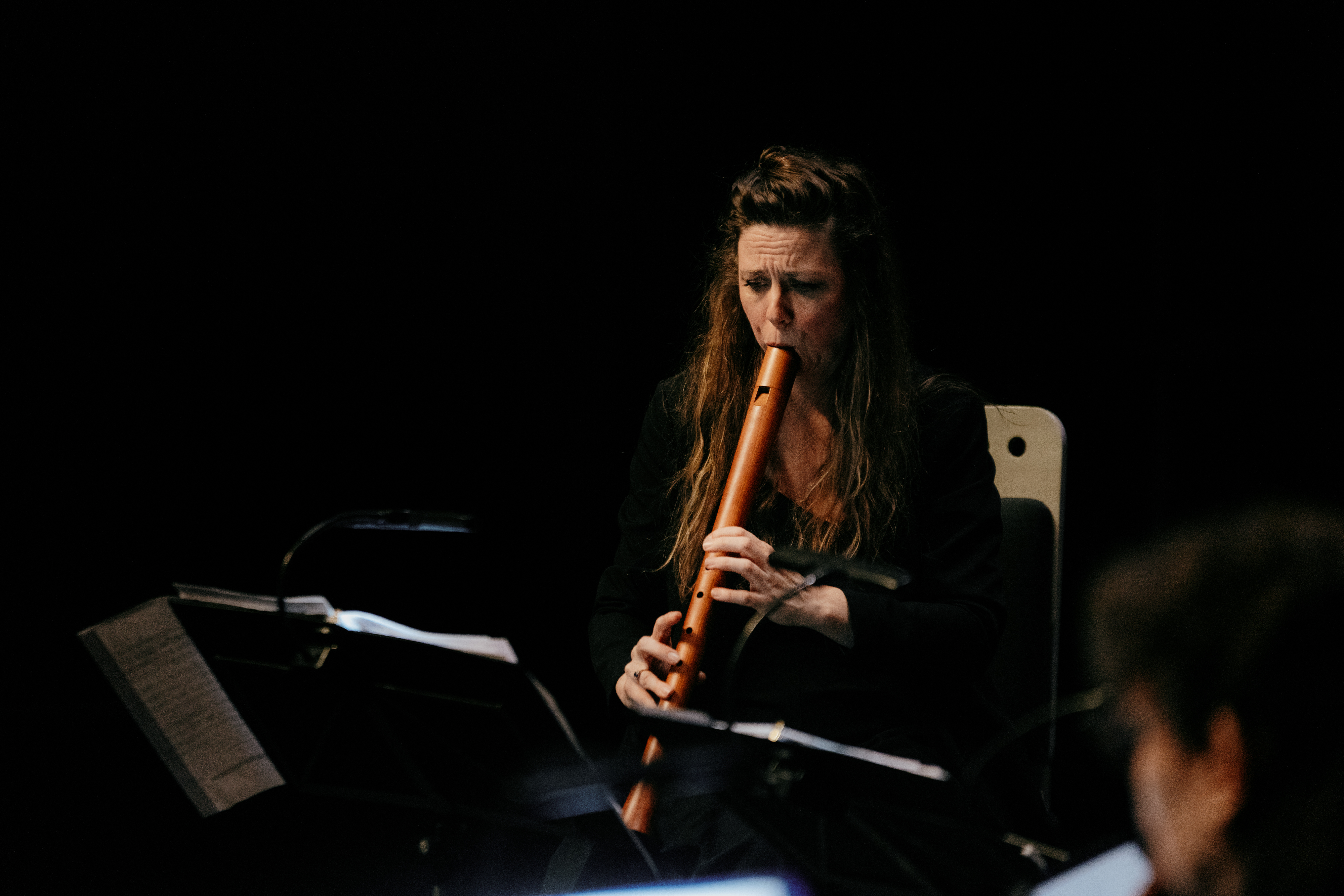
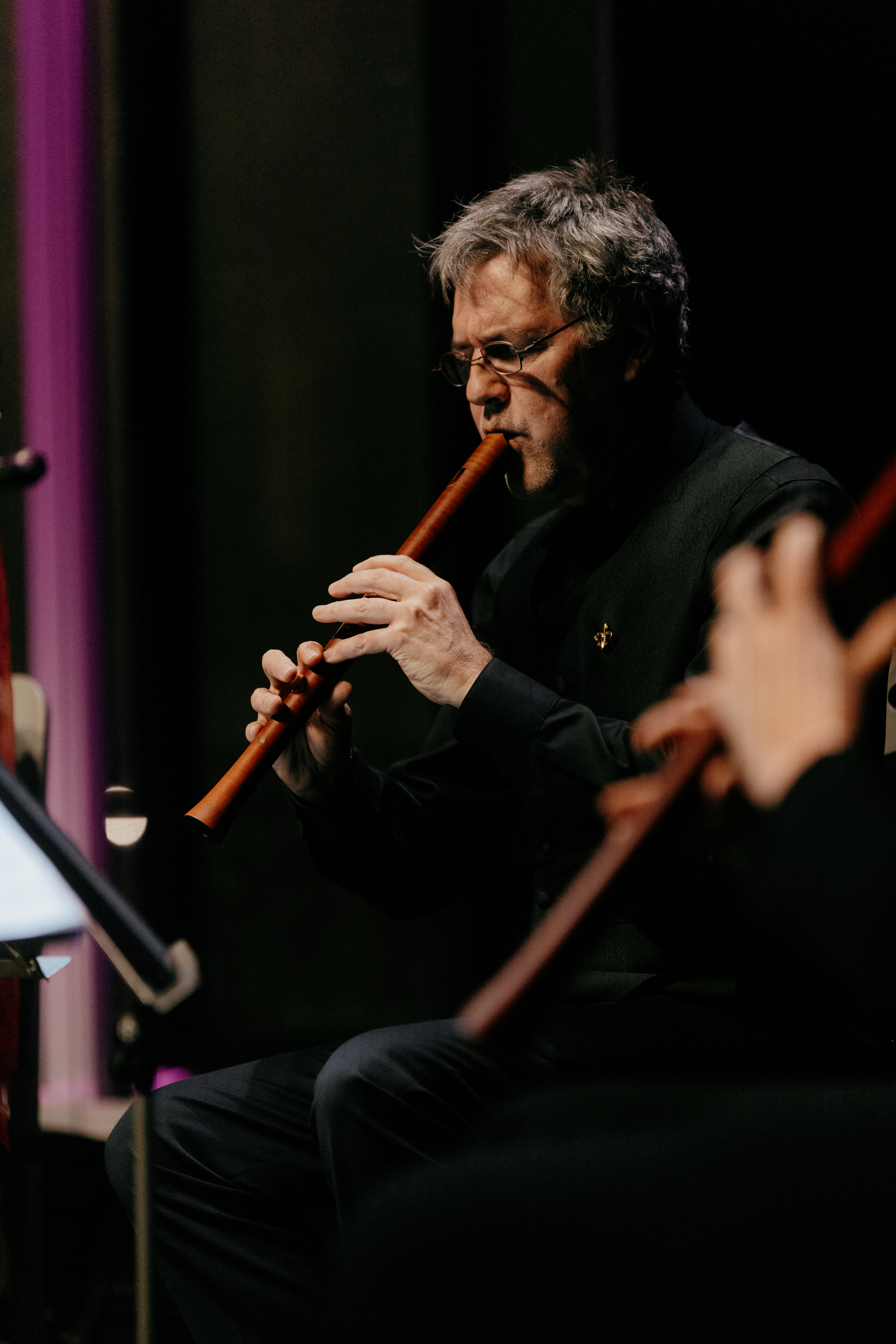
Instrumental performance interested him above all else. “I might have become a more skilled instrumentalist,” he admitted, “if a fire too intense hadn’t driven me to learn, in addition to keyboard instruments, the violin, the recorder, the oboe, the transverse flute, the chalumeau, and the viola da gamba … and including the double bass and the bass trombone.” This practical familiarity with a wide variety of instruments—without reaching the level of pure virtuosity—remains one of the most important keys to grasping Telemann’s art and understanding the nature of his output. Telemann employed all the instruments of his time, blending and arranging them to take advantage of their unique sonic qualities, proving himself thoroughly modern in this regard. He offered the following advice: “Exploit every possibility of each instrument; this will fill the performer with joy, and you will derive pleasure from it.” And he believed that “a composition that contains between its lines ‘witchcraft,’ that is to say, a multitude of difficult passages, is almost always a chore to perform, a fact that is often evident simply from the musicians’ grimaces.” Although not without rapid and perilous passages, his instrumental music avoids the acrobatic virtuosity found at the time among many Italian violinists and offers performers passages whose difficulty is adapted to the technical capabilities of each instrument.

Although Telemann and his compatriots were drawn to the concerto by around 1700, the quintessential symphonic genre in Germany at the time remained the French overture, a term referring both to the overture proper—a movement consisting of a slow section in dotted rhythm followed by a fast fugato, before a shortened reprise of the first section—and to its suite of various pieces, dances, and character pieces, of indeterminate number and arranged with an eye toward contrasting rhythms and tempos. In his Das Neu-Eröffnete Orchester of 1713, Mattheson indeed maintains that “although the Italians go to the greatest trouble in the world with their concertos, which are certainly of extreme beauty, a French overture is nevertheless worthy of being preferred to all these works.” Just as the French, who had initially practiced the form by grouping together instrumental pieces from stage works, were abandoning the genre, the Germans would establish its autonomy and give it new scope, while incorporating solo instruments performing in concert with the orchestra.
This fusion of French and Italian tastes practiced by Telemann would also encompass the folk music he encountered during his travels, whose rhythms and instrumental combinations deeply interested him. While in the service of Count Erdmann von Promnitz in Sorau (now Żary, Poland), between 1705 and 1708, he accompanied his employer to Kraków and Pleß (now Pszczyna), in Upper Silesia, where he appreciated the “barbaric beauty” of Polish and Moravian music, especially that from the folklore region of Hanakia in central Moravia. Several years later, he wrote: “If you know how to turn it to your own advantage, there is so much good to be had from this music… “Later I wrote large-scale concertos and trios in this style, which I subsequently gave an Italian look by alternating Adagios and Allegros.” This is eloquently demonstrated by his Concerto for Traverso and Recorder in E minor, in which, in addition to contrasting the recorder (the flauto dolce) with the newer flute (the flauto traverso, soon to become the champion of sensitivity), he proves himself a precursor to Liszt and Bartok

A Hamburg newspaper reported in 1732: “Music lovers can look forward next year to a major instrumental work titled Tafelmusik (Table music), composed by Telemann. […] Subscriptions open at the beginning of each quarter, and the names of subscribers will be printed in an appendix to the work.”
Thanks to excellent publicity and Telemann’s contacts with distributors and booksellers in Berlin, Leipzig, Nuremberg, Frankfurt, London, and Amsterdam, his Tafelmusik was an immediate success: nearly 250 subscribers responded to the offer, including magistrates, ministers, clergymen, burghers, chapel masters, and musicians of all levels and from all over.
The work is presented in three “volumes,” that is, in three volumes arranged in the same manner, each comprising an overture with its suite, a quartet, a concerto, a trio, a solo—in fact, a sonata with basso continuo—and a “conclusion” which, with the same instrumentation as the overture, functions as the final movement of the suite and completes the cyclical structure intended by Telemann for each of the three productions.
The title of the publication might lead one to believe that the works it contains are merely background music, a sort of soundtrack to various culinary activities. Apart from the fact that this use is obviously not ruled out—as with all chamber music—a title such as Overtures, Concertos, and Sonatas would undoubtedly have had less promotional impact, and musical works written and published with reference to the table had been legion since the beginning of the previous century, reflecting the Baroque aesthetic of the correspondence between human activities and the union of pleasures.
The composition of his concertos apparently caused Telemann particular problems, if we are to believe what he recounts in one of his autobiographies; he writes, in fact, that they did not “flow naturally” and that they are not as successful as he would have wished. With all due respect, we beg to differ! Even today, this part of his instrumental output strikes us as one of the most interesting aspects of his entire body of work. Not only did his concertante writing contribute in its time to the definition of the Germanic musical style and the emergence of a national artistic consciousness, but we still have the pleasure of appreciating its elegance, ingenuity, colors, and unflagging vitality—so representative of that era we like to imagine as one of the good life.
© François Filiatrault, 2026
Translated by Sean McCutcheon